
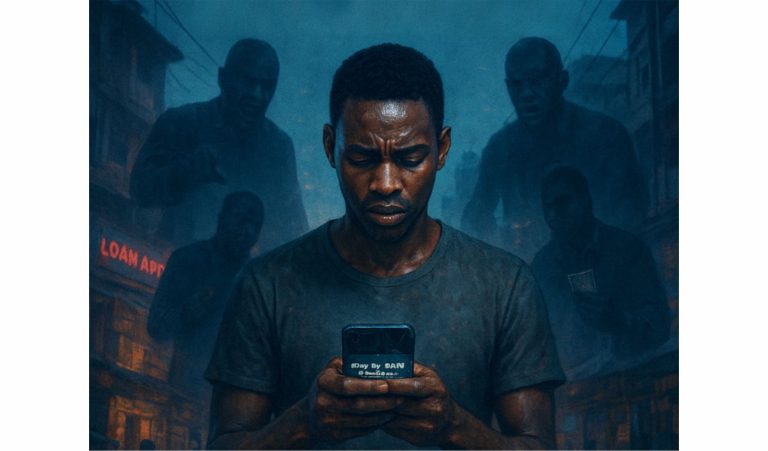
The phone kept beeping as messages poured in one after another, but Marvel refused to touch it. The warning from the previous night was still fresh in his mind. The caller had rung him repeatedly, and when he didn’t answer, they sent a message:
“You have till 9 a.m. tomorrow morning to pay your loan. If not, your obituary will be announced to your immediate contacts and then to the whole world.”
While he was still recovering from the shock of the cryptic message, another one came in—this time containing his full name, bank verification number, home address, and the contacts of his two referees: his wife and Ike, his neighbour, whom he had used for the loan.
He stared at his phone for a long time before roughly pushing it away on the table, as though discarding a sour meal. Then he held his head in his hands. His fingers trembled, and his legs felt weak. The lack of sleep was beginning to take its toll, and the previous night had been the worst. His blood pressure had risen to 180/100, forcing him to check it regularly. No matter how stressful business had ever been, it had never gone beyond 150/80. Even during a two-day toothache, the reading had only reached 150/90.
After receiving the messages, he had thought of ending it all. At first, he tried to push away the thought, but as he smoked stick after stick of London Switch, he allowed the dark ideas to take over. He would use the rope behind the house, tie it to the overhead tank, make a loop for his neck, and drop. No one would notice for days—perhaps until the smell of his decaying body drew attention. His landlord, who lived in the next building separated by a small gate, would probably be the first to notice. He imagined the man peeping through the gate, seeing him hanging there, and shouting in shock as neighbours gathered.
The thought reminded him of Ibe. Many years ago, as a teenager spending holidays in the village, he remembered the commotion one morning when Ibe’s wife screamed that her husband was missing. The villagers quickly organized a search party, combing nearby bushes, but there was no sign of him. Just when it seemed hopeless, someone looked up the big Ukwa tree behind his compound and shouted, “Ebee wu! Ebeee wu!”
The villagers rushed behind the house and found Ibe dangling from the Ukwa tree. He had used a rope from one of his sheep to hang himself. The wrapper tied around his waist had loosened and fallen to the ground, next to a heap of faeces—perhaps released before climbing or while struggling in his final moments. The naked, dangling body was a sight Marvel could never forget, especially with the rumour that Ibe’s ghost would hand the rope to anyone who saw his hanging body. Long after the police had cut him down and taken the body away, villagers remained there, discussing his death and the circumstances that led to it.
Some blamed his wife, saying she had cheated on him and that their four children weren’t his. Others claimed he owed too many people. Yet, what baffled everyone was how a frail, weak man like Ibe could have climbed such a mighty tree to hang himself.
Remembering all about Ibe’s suicide made Marvel think about home—about how his wife would be informed, shocked, and heartbroken, though she would eventually recover. He imagined his four-year-old son, who probably wouldn’t understand what had happened to Apa. At the funeral—if there would be one—his boy would likely be dressed in his birthday clothes, running around and playing with other children. He remembered Joshua, another child who’d done the same when his own father died, smiling innocently at guests and saying, “My papa don die.”
The mental picture of his son at his own funeral jolted Marvel back to reality.
“I won’t kill myself,” he whispered—just as he had told the agent from Sato Lenders when they arrested him after luring him into a fake meeting to “negotiate” an easy repayment plan.
The memory of that incident came flooding back. The loan office was a one-storey building with glass-partitioned cubicles upstairs and an open hall below. The upper floor was occupied by the Chinese owners of the loan app, while the ground floor was filled with rows of young men and women behind tables, clutching smartphones and scribbled sheets of paper. They were the ones calling and threatening debtors.
The place felt like a madhouse. The air was thick with noise—shouting, abuses, and curses. Each agent screamed into their phones, unleashing insults on whoever picked up. The ground floor had no air conditioning; sweat poured down their faces as they wiped themselves with their palms.
One of the Chinese men, a short, wiry fellow with a permanent scowl, walked down from the upper floor. He paced behind the agents, occasionally shouting at them in broken English, echoing their curses. Within minutes, he dragged a lady out of her chair and pointed at the door. She left without taking anything, not even the company-issued phone.
While Marvel watched in disbelief, four security men appeared and began dragging him toward a small door. He was shoved into a toilet and locked in with other debtors. The cubicle was barely six feet wide, the stench of faeces and urine hanging thick in the air. A man sat on the toilet flush, his legs perched on the seat, while two women stood pressed against the walls. No one spoke; only one of the women sobbed quietly.
After nearly an hour, the door creaked open, and another Chinese man stepped in. He was tall for his kind, with thin legs supporting a heavy frame. His patchy beard resembled a spider web, and he held a cigarette and lighter in one hand.
“I’m Chen Die,” he introduced himself. Marvel frowned at the name. Chen Die asked if they had contacted their relatives to pay their debts so they could be released. No one responded.
When he left, the man sitting on the toilet finally spoke.
“That’s the owner of the app,” he said. “He brags about how many people he’s held here. This isn’t the first time they’ve kidnapped me. Yes, kidnapped—because that’s what this is. They hold us here and pressure our families to pay.”
He explained how the entire operation worked. The Chinese owned the apps and hired locals, forcing them under immense pressure to issue loans, sometimes even to unwilling borrowers, to meet targets. Then they harassed and humiliated debtors into repayment. The interest rates were outrageous, and many couldn’t pay back. Some repaid only to qualify for higher loans, but the apps would immediately block them.
Most of these apps weren’t registered or approved by any government agency, and consumer protection authorities had no idea they existed. The masses were left at the mercy of these digital loan sharks, terrorized by their own desperate countrymen working for the Chinese owners.
The man pointed at the weeping woman.
“She’s scared because someone died in this same toilet yesterday, and nothing happened,” he said quietly.
The woman wiped her tears and spoke up. “I owed only five thousand naira,” she said. “I came here myself to tell them I lost my phone, that’s why I couldn’t pay. But a day before the loan was due, the agents started calling my contacts and sending them edited nude pictures of me and my family. One even used my photo as his display picture so that when they called, people would think I was the one. They charged me ten percent interest every day. My customers came to my canteen, showing me the pictures.”
She paused, sobbing harder. “They don’t want repayment. They just want to destroy you.”
The second woman spoke next. “They couldn’t find my husband, the one who took the loan, so they picked me up instead. Before that, they shared his photos on WhatsApp, Facebook, Instagram—even posted a video on TikTok with his picture and those of other debtors, with music playing in the background saying ‘Pay us our money!’ They added a caption saying he had HIV/AIDS and had escaped from a psychiatric hospital, warning anyone who saw him to report to the police.”
From outside the smelly toilet, they heard a shrill female voice, a Chinese one, singing mockingly: “No money, frustration, depression, suicide! Frustration, depression, suicide!”
Her tiny voice echoed through the building.
It was then Marvel realized that all his emails and calls complaining about the agents’ behaviour had fallen on deaf ears. The agents were simply doing what they were told.
By evening, he was taken to a police station, thrown into a cell with hardened criminals, beaten, and slapped by officers demanding repayment. Their boss eventually told him to get someone to bail him out, setting the bail at ₦20,000.
An old school friend had sent the money, but Mr. Kalu, who came to bail him, didn’t even have enough for transport and had to be reimbursed with interest. It wasn’t the first or second time Kalu had come to his rescue. He often followed Marvel from one station to another to ensure he wasn’t detained.
Mr. Kalu understood his struggle. His textile business had collapsed after a shipment sank at sea. Since then, he’d mastered the art of dealing with the police, negotiating bribes down from ₦100,000 to ₦10,000. He believed in Marvel more than Marvel believed in himself. Once, he told him confidently, “You’ll be back on your feet in six months.”
Mr. Kalu also knew how to handle the loan sharks. No matter how rude or abusive they became, he would respond calmly, saying, “I didn’t come to quarrel or fight. I came to find a solution.”
Through all the trials, the Chinese owners never showed up at the police station. They sent only their Nigerian enforcers.
Outside the station, the words of one agent still haunted Marvel: “If you can’t pay the loan, kill yourself. That way, the insurance will clear it, and you’ll finally be free.”
Marvel had walked away that day. But now, those same words echoed louder than ever.
He stood up and went to the toilet. He couldn’t stand for long, so he sat on the seat and urinated, then remained there, staring blankly into the sitting room. The house felt empty. He had sold all the electronics to repay part of the loans, tormented by both the agents and the police. The furniture had also been carted away by another agent who ambushed him one morning with their recovery task force and the police.
That morning, as he stepped out to buy cigarettes, they stopped him and forcibly entered the house. He didn’t resist, remembering the landlord’s warning not to cause any more trouble in the compound after the last incident—when loan agents and police officers mistakenly went to the landlord’s apartment instead of his. He had also heard that, in recent weeks, a debtor who tried to fight the recovery task force had died in the process. As people said, nothing would come out of it.
So, he simply stood aside and watched as they carted away all the chairs, the centre table, and the television stand. They even tried to take the kitchen gas cylinder and utensils, but one of the policemen insisted they leave them. Thank God they came very early—probably waited outside all night—because neither his neighbours nor the landlord knew what had happened until they left.
Beyond seizing his property, the agents violated his personal space with constant calls, text messages, and threats. As the pressure mounted, he borrowed from more loan companies to offset older debts, falling deeper into the trap. There was nowhere else to turn. Mr. Kalu eventually suggested a loan shark with higher interest but more flexibility—someone who, he said, would give Marvel time and space to do his business and stay away from the police and agents who took a ten percent commission on every repayment they recovered.
At the bus stop leading to the lender’s house, Marvel noticed several abandoned cars. People said their owners had defaulted on loans and fled. Many believed these lenders were diabolical, capable of using charms or curses to ensure borrowers couldn’t repay, so they could seize their property as collateral. He had shared these fears with Mr. Kalu, but his friend reassured him that this lender wasn’t like the rest—besides, Marvel had no collateral to offer anyway.
Inside the compound, the lender sat with two other men, probably potential borrowers. When they arrived, he stood, shook Mr. Kalu’s hand, and nodded briefly at Marvel. He asked them to wait at another table, away from where he conversed with the men. After nearly an hour, the men left, and he beckoned to them.
At the table, Mr. Kalu explained why they came. The lender asked Marvel how much he needed and what the money was for. Marvel didn’t disclose that the loan was meant to pay off other debts. He told the man it was for his business.
The lender studied him for a moment, then said, “I hope you’re not like those who, once they get a loan, their prick will stand, and they start chasing women instead of paying back?”
Marvel was shocked. His throat tightened, and tension flooded his chest. He wanted to speak—wanted to tell the man how much he’d lost in the housing project that collapsed after he supplied goods worth millions, how he had spent hundreds of thousands trying to recover even part of the payment, how the developer had bribed his way out, and how even the police looked the other way. Taking the matter to court had been another nightmare; adjournment after adjournment until it felt pointless.
His mouth stayed open, but no sound came. In his mind, though, he relived that terrible day.
He had received a call from Chima, one of the other suppliers, around 4 a.m. The man’s voice was frantic, shouting, “I am finished! I am finished!” In the background, Marvel heard a baby crying and a woman’s voice pleading, “Chima, please, it’s not the end of the world.”
Marvel had tried to calm him down, not realizing what had happened. He thought Chima had lost someone. Then the woman grabbed the phone and cried, “The building collapsed! The five-storey building is gone!”
He rushed to the site thirty minutes later. The entire building had crumbled into a grotesque heap of concrete and dust. Mr. Segun, the developer, was on his knees, shouting, “Oluwa mi! Oluwa mi!” When the Baale of the community told him to thank God no one had died, the man screamed, “It has killed who it will!”
It was Mr. Kalu who answered the lender now, assuring him that Marvel wasn’t like that. The lender got up and went inside. When he returned, he shook his head. “I can’t give you the loan,” he said flatly.
Marvel looked at him, knowing pleading would be useless. When a lender says no, there’s no point begging; sometimes their refusal isn’t even based on reason; they just want to see how much their rejection hurts you.
There were times he had borrowed from one loan app to pay another, hoping to qualify for a higher loan, only for the app to block his account. Other times, they’d contact him first, luring him with promises, then impose outrageous interests and hidden charges. Out of desperation, he took them. The system was a web—loan sharks operated like a cult, sharing debtor information, owning multiple apps together. As time went by, he sank deeper and deeper until he couldn’t climb out.
Looking at the lender before him, he realized how powerful the man felt simply by saying no.
The phone began to vibrate on the table again. For weeks, he had ignored his calls, tired of the endless harassment. Sometimes the calls continued until the battery died. He wanted to ignore it again, but a strange impulse made him check the screen. It was Judy.
His mind raced. Had they called her again? Threatened her? Sent those cursed messages filled with abuse and damnation?
When it started, Judy used to cry and question everything aloud. “How do you curse people you’re doing business with? How do you get customers that way?” she’d say. But over time, she grew used to it, or perhaps she had simply given up. The agents always had new unregistered numbers. Blocking one was pointless. Eventually, she stopped answering and stopped reading their messages.
Marvel cleared his throat and picked up the phone. “Hello, honey,” he said.
But it wasn’t Judy’s voice that answered. A harsh male voice shouted, “Where are you? We’re in your house! If we don’t see you in the next hour, we’ll pick up your wife!”
His breathing grew shallow. He dropped the call, panic flooding his chest. The image of Judy in police custody flashed before him. He dialled back the number. This time, Judy answered softly, “Hello?”
“I’m coming, honey. Don’t worry, everything will be okay.”
“I know,” she replied, but her voice was broken.
When he got home two hours later, the gate was locked from the outside. He called her number again, but it was switched off. He hurried to the police station. There, he found her sitting on a long bench among other women arrested for fighting.
He rushed to her. “Why is your phone off?” he asked.
“The police officers told me to switch it off,” she replied quietly.
“Where’s Kamsi?”
She pointed to the far end of the station. Kamsi was playing with a policeman’s AK-47. The officer had slung it around the boy’s neck, and Kamsi was laughing. Marvel walked up quickly, removed the gun, and carried his son back to his mother. He wanted to scold her but knew it would only worsen things.
When the loan agent and the police officer noticed him, they told Judy to leave with the boy. Then they handcuffed Marvel. He protested, reminding them that he was already on bail, but they pushed him into a police van and drove off.
Inside the van, no one spoke until they reached the courthouse. A lawyer approached and asked the agent, “Is this the debtor?” The agent nodded. The lawyer turned to Marvel and said coldly, “Oga, you’re going to jail.”
Inside the courtroom, the lawyers addressed the magistrate, speaking in legal terms he barely understood. Another lawyer approached him and said, “You can go home. Pay them their money and stay off debt.”
He was stunned, dazed, as though he were dreaming. Then he saw Mr. Kalu enter the courtroom and take his hand.
Outside, Mr. Kalu explained that Judy had informed him, and he’d hired a lawyer. The magistrate had said their books didn’t add up—that it was a civil case, not a criminal one—and struck it out.
Marvel was too drained to speak. “Go home,” Kalu said gently. “Spend time with your wife. She’s worried about you.”
As the bus approached his stop, Marvel felt a wave of relief. For the first time in months, he was sure of where he would sleep that night—and with whom he would wake in the morning.
The small apartment he’d rented near the factory had become a haunted house. The loan sharks visited without warning, and if he was home, they’d drag him off to the station. But this time, they’d gone to his family’s house.
When he alighted, he decided to walk the short distance home. Every naira counted now, and besides, he needed to clear his head. But his mind refused to quiet down. He kept thinking about how Mr. Kalu had hired a lawyer on credit—another debt waiting to be paid.
As he neared the compound, he saw three cars parked out front. One of them belonged to his pastor. A heavy sigh escaped him. The same pastor he’d once helped financially, donating generously to the church whenever there was a need. Judy had even invited him for lunch a few times.
But when Marvel’s business collapsed and he told the pastor how bad things had gotten—how he was tired of life—the man said there was nothing he could do. The next Sunday, the pastor’s sermon topic was suicide.
He tried calling Judy to ask why the pastor was at their house, but her phone was still off.
At the chemist’s shop two buildings away, he stopped to greet Chidozie, the chemist. The man hesitated before shaking his hand, then quickly withdrew it. Something felt off.
When he got to the gate, it was open. He had warned Judy countless times never to leave it that way.
He opened the sitting room door and stepped inside. Judy wasn’t there. The pastor and two men were sitting quietly, talking in hushed tones. The moment they noticed him, they all stood up abruptly—as if stung.
Judy walked out from the bedroom. “I told you it was a rumour,” she said.
Marvel looked from her to the men. “What rumour?” he asked.
Judy came closer, standing beside him. “They said you died,” she said softly. “I told them it wasn’t true—that Mr. Kalu went to court to bail you.”
Two women from the church appeared from behind her, their faces pale, as though they had truly seen a ghost. Then it dawned on him. The loan company that had threatened to announce his obituary had actually carried out their threat.
Marvel took a deep breath, looked around the room, and said calmly, “I am not dead—and I’m not going to die anytime soon.”
Then he turned, walked into the bedroom, and shut the door.
The End.